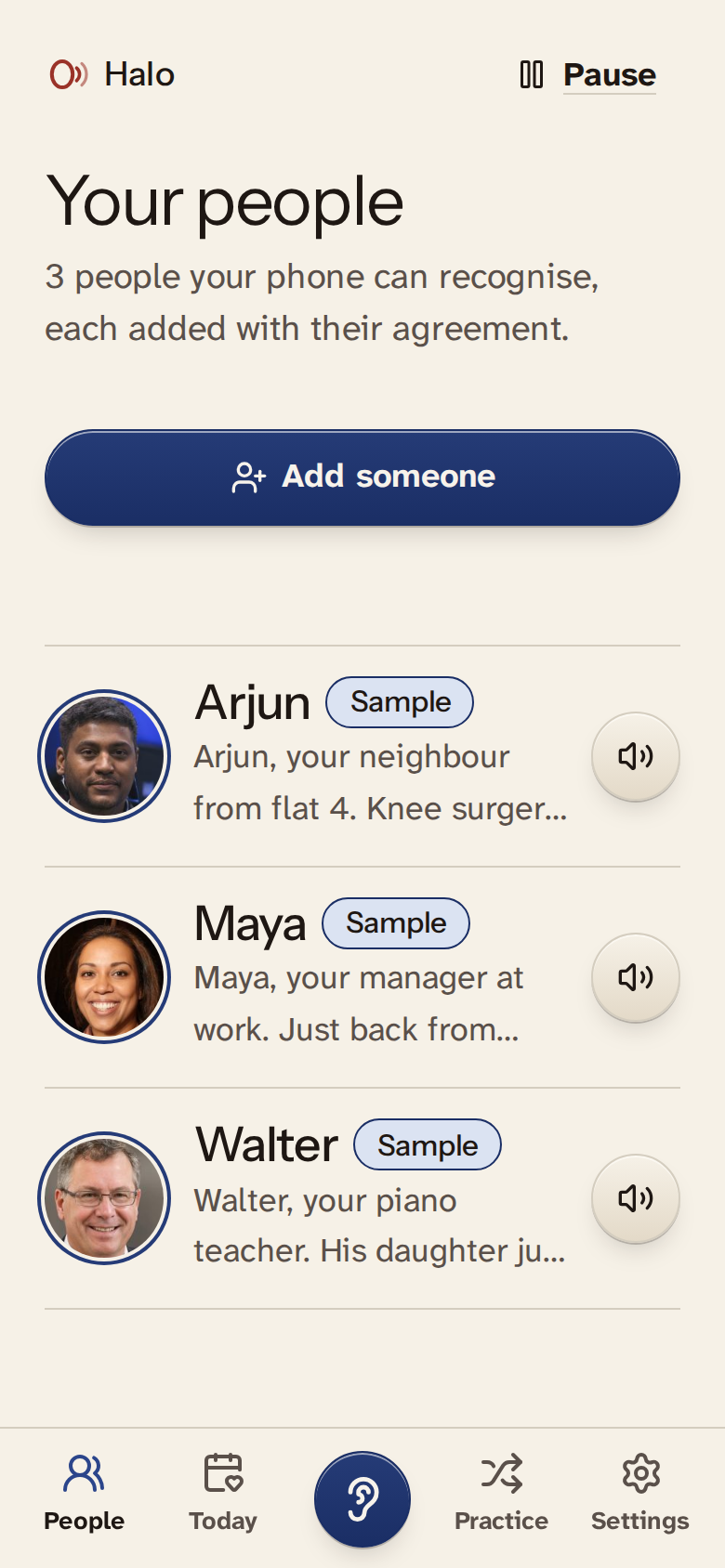
A quiet voice for faces you know.
For face blindness: a whisper of who, and how you know them.
What people with face blindness ask for
Roughly 2% of people have lifelong face blindness, while most of us know about 5,000 faces.
-
u/Adventurous_Kiwi“What we need is some dude saying in our ears "yes , you know that person it's insert name"”
-
u/Adventurous_Kiwi“My boyfriend does it for me. I need that but like, in my earphones, for when he's not around.”
-
u/HereForMcCormackAMA“The contact cards would not help me, unfortunately. I'd only be practicing to recognize that specific picture of my friend.”
Quotes from public posts on r/prosopagnosia, shown word for word. Numbers: Kennerknecht et al. 2006 (2.47% of 689 students; later estimates range from 0.64% to 5.42% depending on the cut-off, DeGutis et al. 2022) and Jenkins, Dowsett and Burton 2018.
-
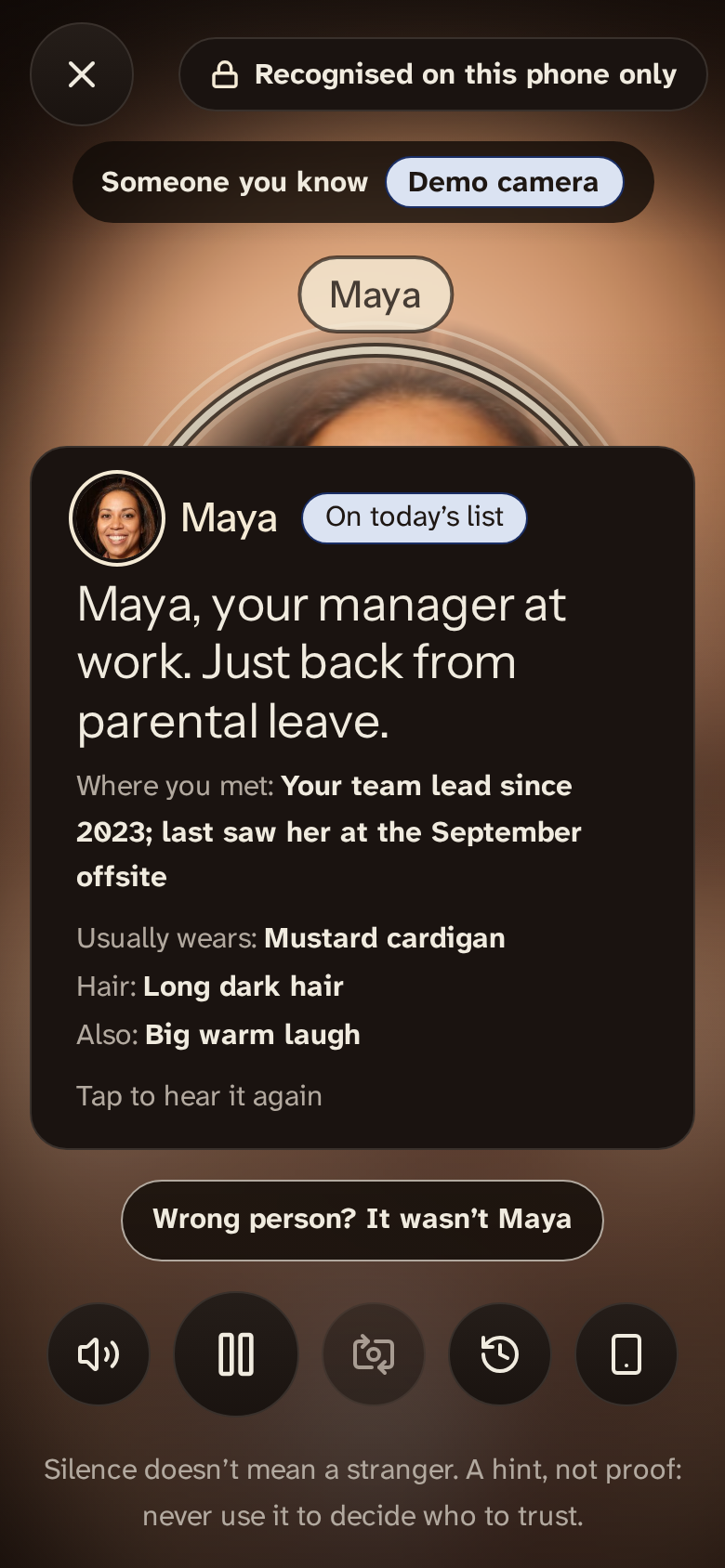
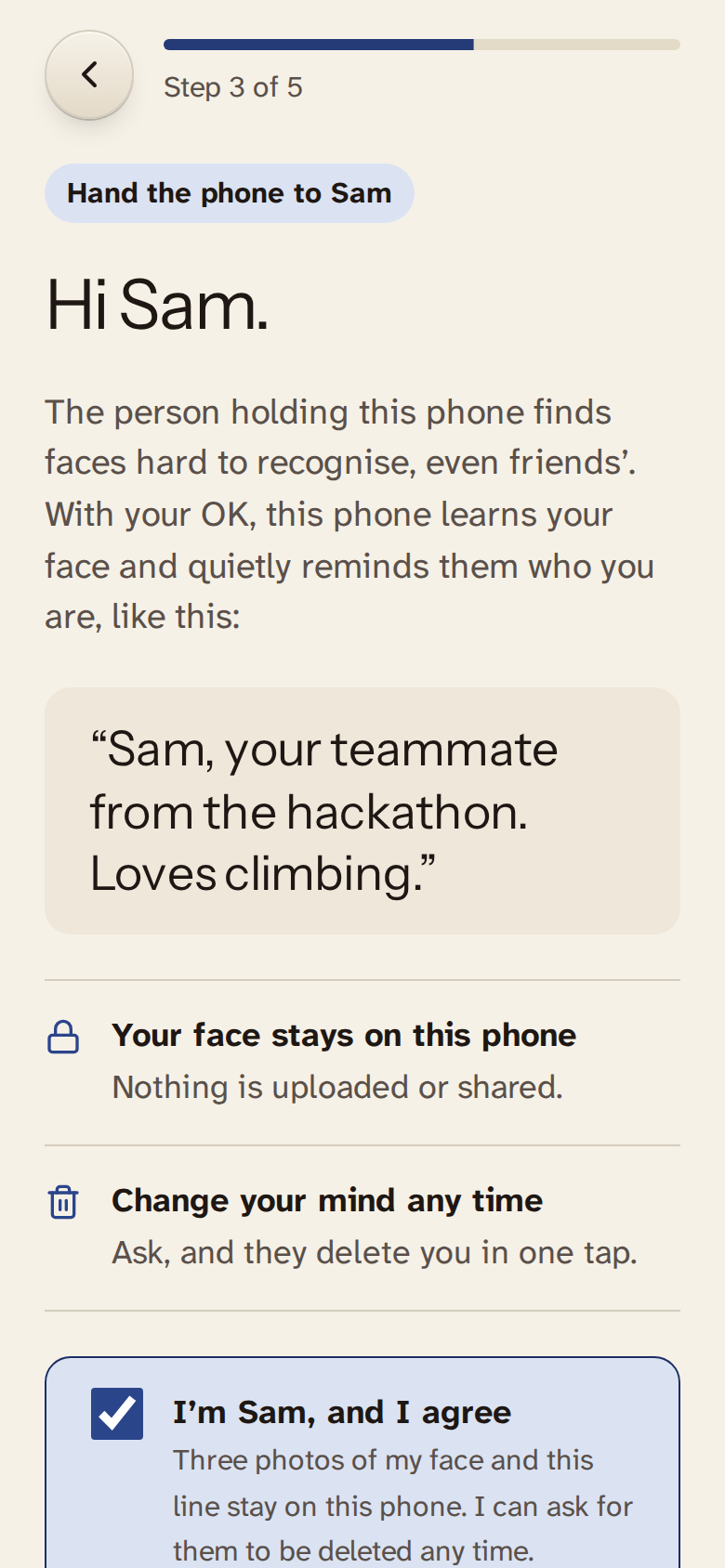
They say yes.
Hand them the phone. They read the exact line it will whisper, and agree themselves.
-
A note becomes a line.
Type how you know them. The phone turns it into one line, offline.
-
Hear who it is.
Once it’s sure, a light halo settles round their face and your earbud says the line. Short, warm or full.
Raj, your neighbour.
-
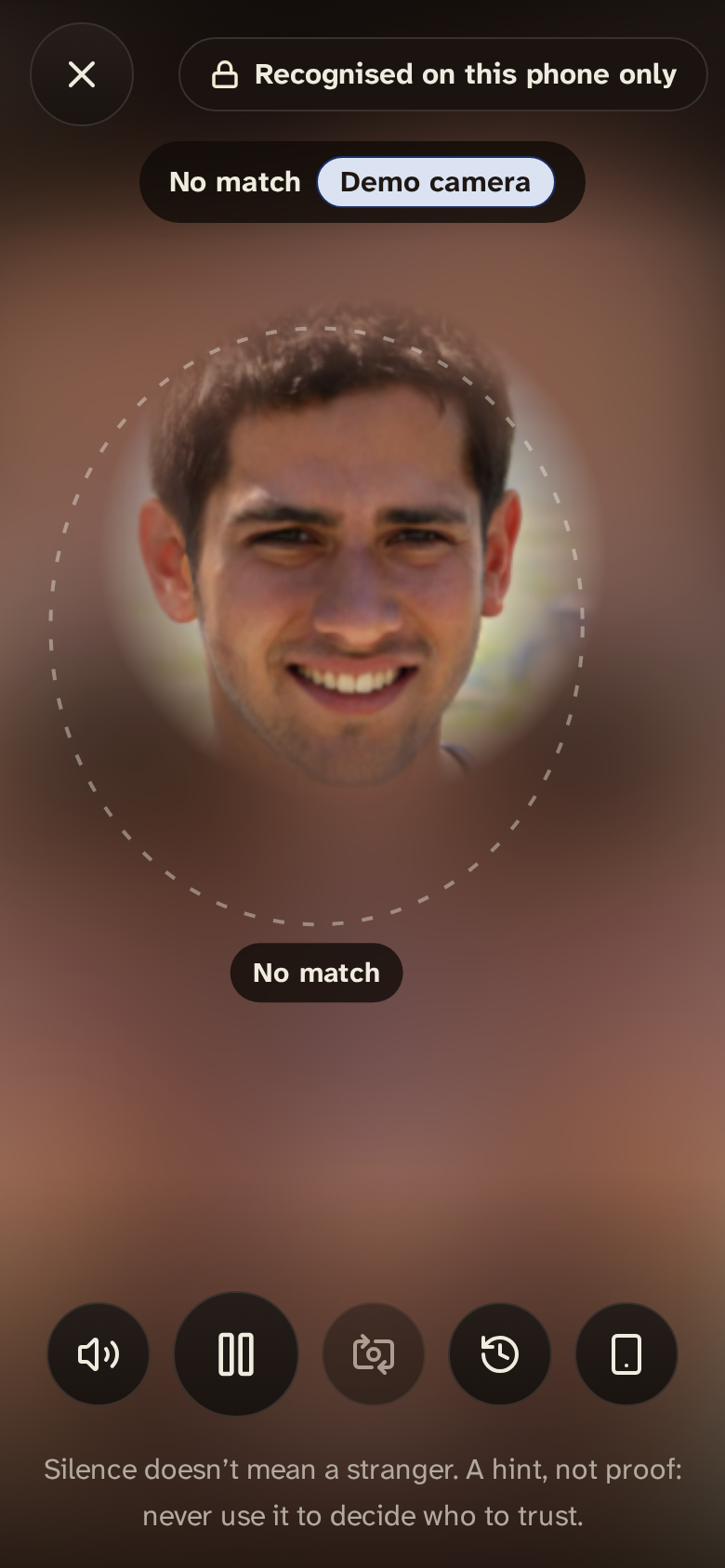
Not sure? It says so.
“Could be Raj? Check: green parka.” Anyone else is “No match”, never stored, never named.
Before you walk in
Preparation and cues, the things people with face blindness already rely on.
-
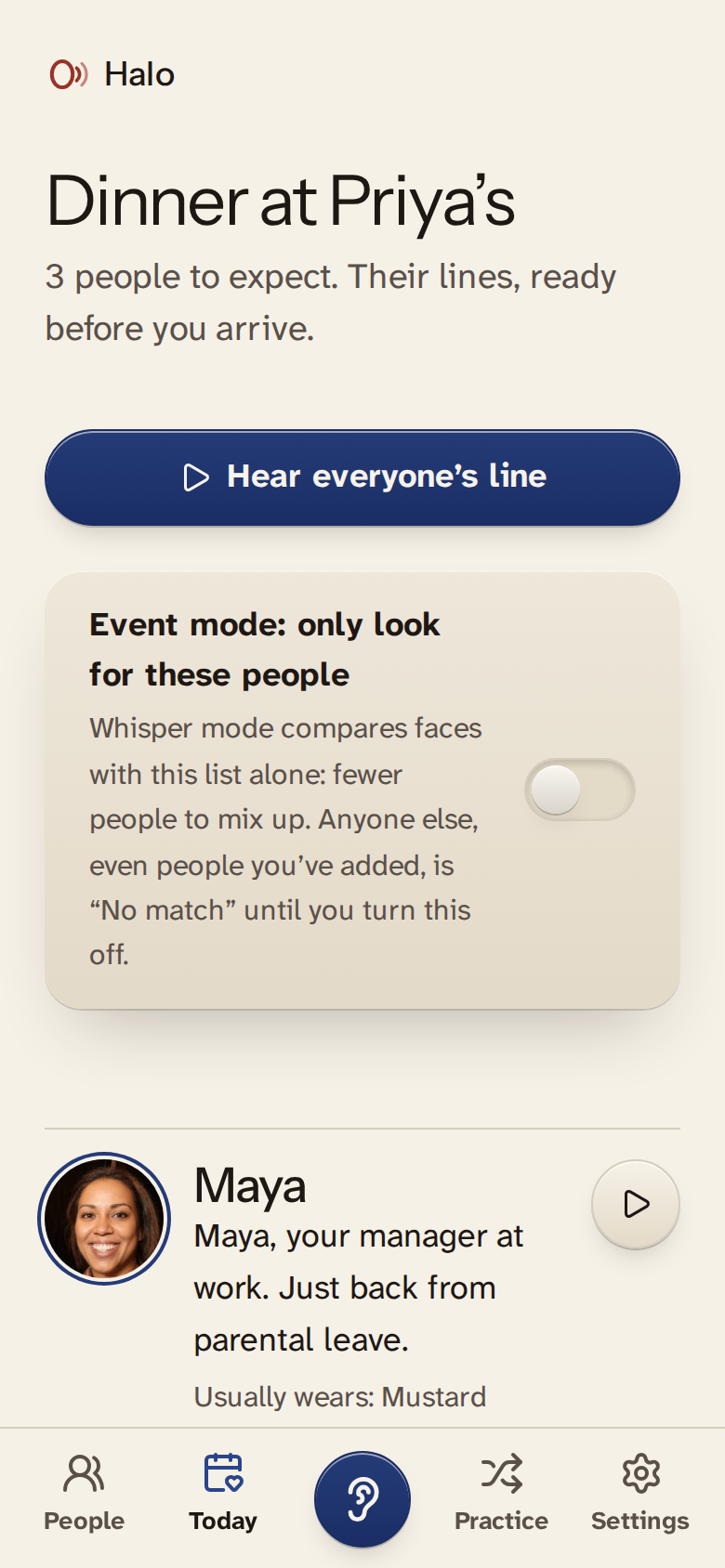
Today’s list
Pick who’ll be at dinner and hear their lines on the way. Event mode looks only for them.
-
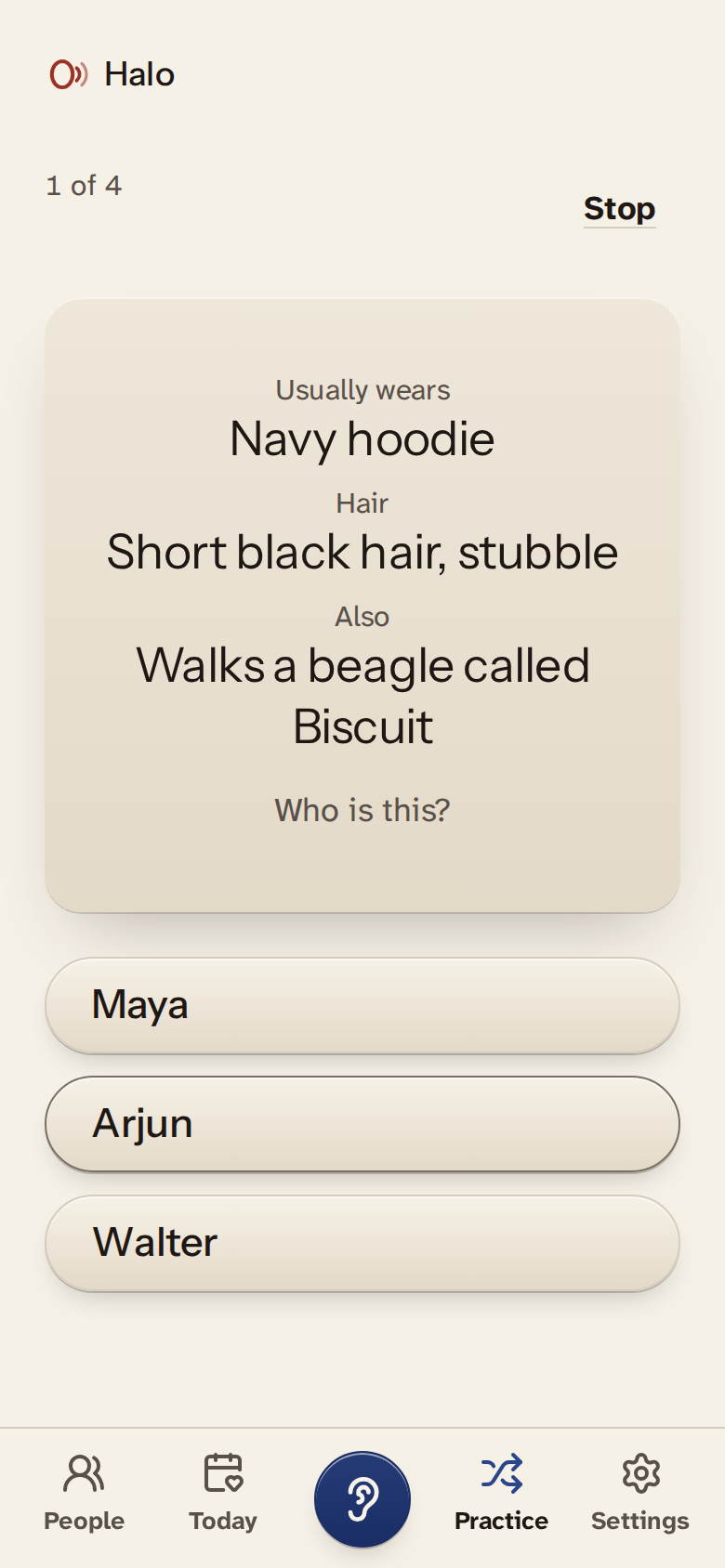
Practice from cues
Clothes, hair, voice: name people from what you notice. No streaks.
-
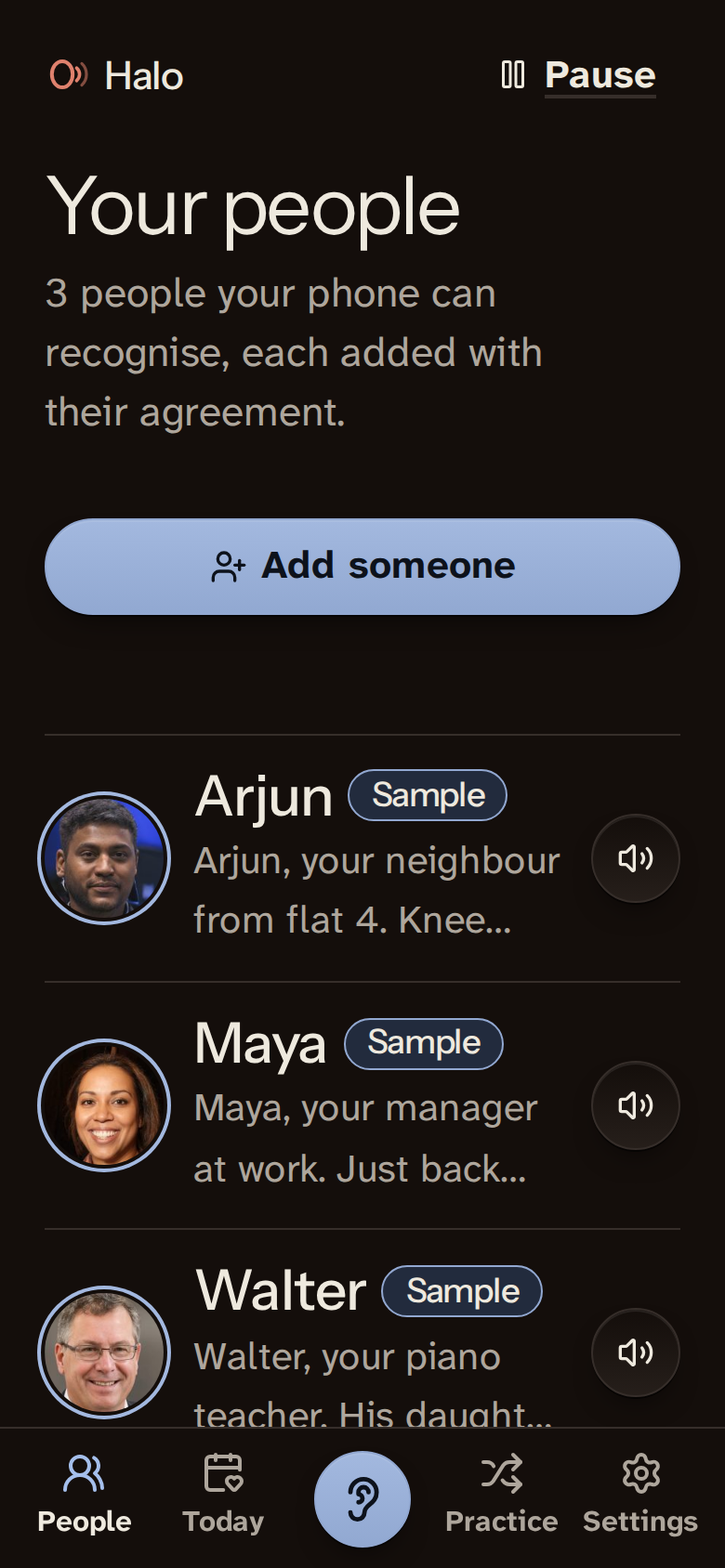
Bigger text, night colours
Every screen a size larger, in day or night.
Faces never leave your phone.
“...But would I want Meta knowing that much about me...”
- Recognised on the phone
- In the browser. No server, account or key.
- Only people who said yes
- They read their line and agree on your phone.
- Every face measured, then dropped
- Checked against your list for a moment, never kept.
- Encrypted at rest
- With a key the browser won’t export.
- Works offline
- After the first visit.
- Delete everything
- One button, every person and the key.
Honest limits
- A hint, not proof. It can name the wrong person, especially relatives, look-alikes and children. Never use it to decide who to trust or let in.
- Silence doesn’t mean a stranger. Dim light, side angles, masks, new glasses or a haircut can stop a match.
- It works better for some faces than others. Open face models make more mistakes for darker-skinned and East Asian faces, women, children and older people.
- It only knows people who said yes. It can’t look anyone up. Each face in view is measured for a moment, checked against your list, then forgotten.
- The app records that you asked them, but it can’t check. Remove anyone the moment they ask.
- A prototype, tested so far mainly on AI-generated faces, not yet with people who have face blindness. Without earbuds, your phone speaks out loud.
Fair questions
- Doesn’t this exist already?
- Taught faces do: OrCam MyEye and Envision’s Teach a Face name faces for blind users, and NameVault drills names from photos. Halo is for people who see but can’t place faces: how you know them, your cues, a briefing before an event, their own yes, free in a browser.
- Won’t I look odd holding up a phone?
- One person put it plainly: “I feel like that's more in the realm of smart glasses than phones because I'm not going to go around pointing my phone at everyone.” (u/Ilaxilil) Pocket mode helps: the phone hangs at chest height, camera out, screen dark, and you hear the whisper or feel a buzz code. Today’s list and cues need no camera at all.
- What if faces aren’t how I recognise people?
- Many don’t: “I recognise people by cues - largely their voices” (u/SybariticDelight). Cue notes and practice are built for that.
- What does it need?
- A phone with a camera and a recent Chrome, Safari or Firefox. Earbuds for the voice; otherwise a buzz and the name on screen.
See it in 60 seconds.
Three AI-generated faces, recognised live in your browser. No camera, no sign-up.
Start the minute